
For your work You type “Write a blog about digital marketing.” A few seconds later, ChatGPT gives you a complete article. It has headings, bullet points, a conclusion. And yet, something feels wrong. It sounds generic. But The examples do not fit your business. The tone is not right. Half the article says things you already knew.
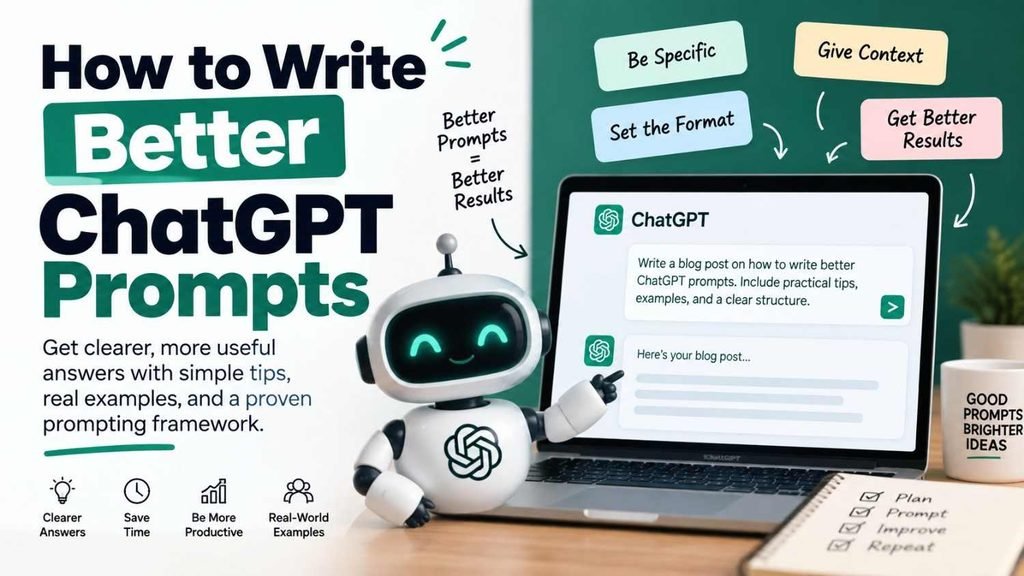
So you try again “Make it better.”
But The result changes, but not enough. Then you add “Make it professional, engaging and SEO-friendly.”
Now you have a longer version of the same generic article. If this sounds familiar, you may not have a ChatGPT problem. You may have a prompting problem. You do not need to learn complicated AI algorithms. You need to learn how to ask for what you actually want.
Imagine you are asking “Create a marketing plan.”. They would probably ask you questions.
- For which business?
- Which customers?
- What budget?
- What is the goal?
- Which channels are already working?
- What does success look like?
ChatGPT faces the same problem. But When you write “Create a marketing plan for my business.”You are showing too many decisions open.
But you completely Tell the ChatGPT Compare that with
“Create a three-month marketing plan for a small online accounting service targeting freelancers in India. Our monthly marketing budget is ₹50,000. We currently get most leads through referrals and want to increase organic search traffic. Suggest three priority channels, weekly actions, estimated KPIs, and a simple measurement plan. Avoid strategies that require a large advertising budget.”
Now ChatGPT knows- What you want, Who the audience is, What business you are talking about, What resources are available, What problem you are trying to solve, What the output should contain.
That is very easy to task to answer. OpenAI recommends define the task, provide relevant context, and describe what a useful response should look like.
How to Write Better ChatGPT Prompts Best Tips
1. Tell ChatGPT Who the Audience Is
You can tell the ChatGPT who is your target audience for example “Explain basic cybersecurity to a small-business owner with no technical background.”
2. Specify the Format
If you need a table, ask for a table. If you need five bullet points, ask for five bullet points. If you need an executive summary, say so. For example “Summarize this report in a table with four columns: issue, evidence, business impact, and recommended action.”
3. Give Examples
If you want a specific writing style, provide an example “Here are three examples of our existing product descriptions. Study their sentence length, vocabulary and structure. Write a new description for our latest product using the same general style. Do not copy phrases directly.”
4. Set Boundaries
Tell ChatGPT what it should not do. “Do not invent statistics.”, “Use only information from the attached report.”, “Flag information that is missing.”,“Avoid technical jargon.”,“Keep this below 500 words.”, “Do not make claims that cannot be supported by the source material.”
This becomes especially important when working with business data. OpenAI recommends checking important results yourself and asking ChatGPT to identify limitations, missing data, or unusual values when analyzing numbers.
5. Stop Saying “Make It Better”
“Make it better” it is simple, but it tells ChatGPT very little.
Try- “Cut the introduction by half”, “Make the explanation suitable for beginners”, “Replace the generic examples with ecommerce examples”, “Remove repeated points”, “Make the tone sound like an experienced colleague rather than an advertisement.”
How to write better ChatGPT prompts?
To write better ChatGPT prompts, clearly explain your goal, provide relevant context, identify the target audience, specify the desired output format, and mention any limitations or requirements
How can I improve my ChatGPT responses?
You can improve ChatGPT responses by giving more relevant context and specific instructions.
What is prompt engineering in ChatGPT?
Prompt engineering is the process of designing and refining instructions given to an AI model to get a more useful response.
Can I use a ChatGPT prompt template?
yes
What is the easiest formula for writing better ChatGPT prompts?
Goal + Context + Audience + Output + Limitations